“Where Learning is Law, and Knowledge Governs All.”
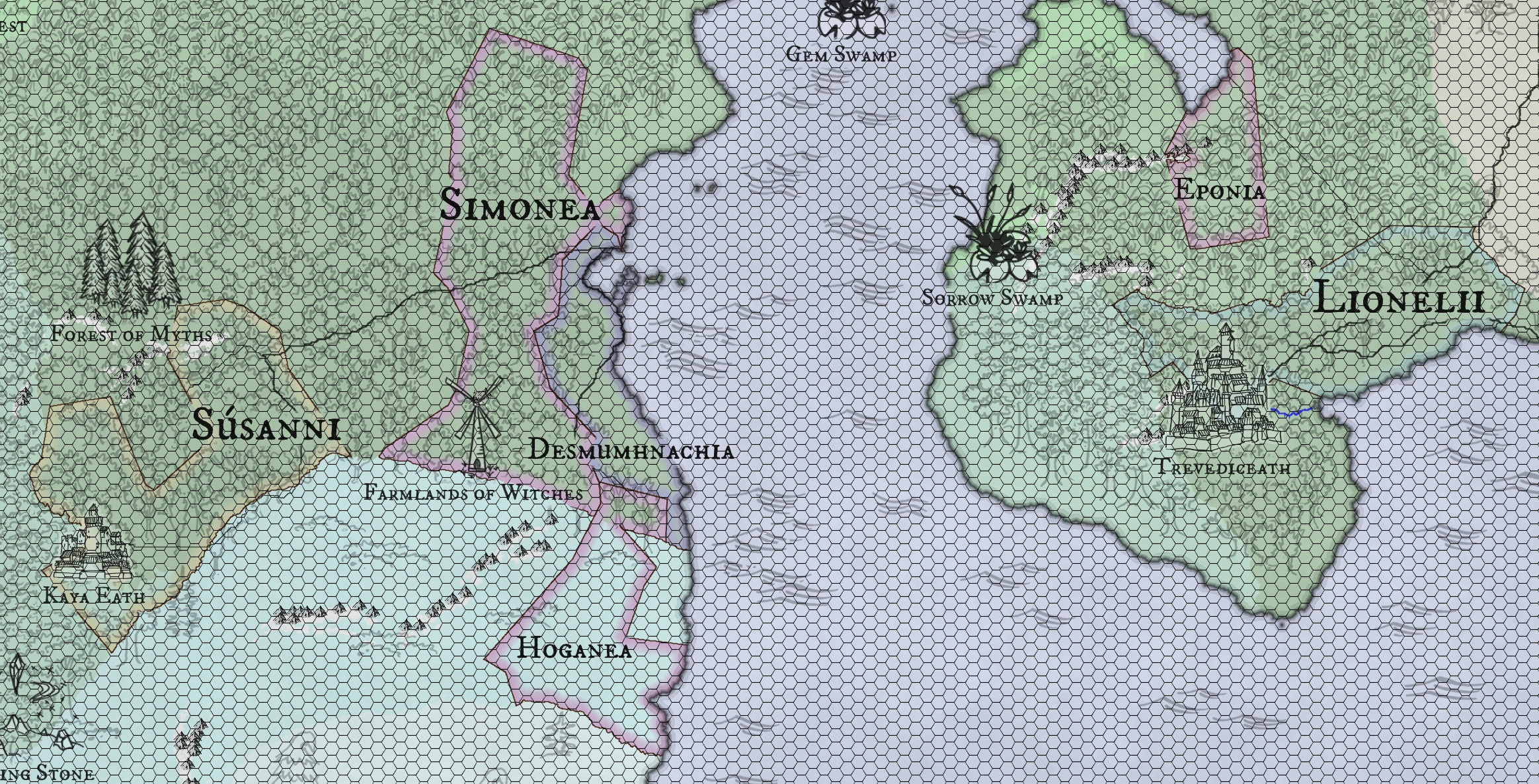
The University of Hoganea stands as a sovereign city‑state dedicated to the stewardship of non‑magi-cal knowledge and the promotion of a revolutionary intellectual order. Its influence permeates every corner of the Known World through a network of educational outposts, scholarly councils, and unique diplomatic privileges. Born of crisis and ideologically forged in rebellion, its legacy is inseparable from the groundbreaking Numeric Philosophy that redefined elven thought.
Historical Foundations and the Numeric Philosophy Schism
Kharis Farnorin’s Vision In 2130 IM, Kharis Farnorin emerged in Simonea as an unconventional theorist who proposed that abstract philosophical concepts could—and should—be expressed in precise, quantifiable terms. By replacing vague metaphors with structured, numerical equations, Farnorin provided scholars with a tool for analyzing ethics, governance, and metaphysics with unprecedented precision. Initially dismissed as eccentric, her ideas soon captivated the intellectual elite of Simonea.
Ideological Dominance and Breakaway
By 2180 IM, Numeric Philosophy had ascended to a domi-nant position among Simonea’s leading thinkers. As her method challenged the prevailing arcane doctrines and traditional mage‑led government structures, a rift formed between the revolutionaries and conservative traditionalists. Those who embraced Farnorin’s rigorous system believed that intellectual autonomy could be achieved only by decoupling philosophy from mystical dogma. When it became apparent that Simonea’s rulers would never welcome a full expression of this new worldview, dissenters rallied—and in 2184 IM, the breakaway state of Hoganea was founded.
Institutional Birth
At its inception, Hoganea was established as a bastion of radical thought and intellectual rebellion. Recognizing the need for an institution that not only nurtured but also protected these ideas, the founders appointed Kharis Farnorin as the first Dean of Philosophy. Under her guidance, the University rapidly evolved into the preeminent academy for structured, numerical in-quiry, influencing diverse fields from governance to art.
Institutional Structure and Global Presence
Central Governance
The University’s heart is its independent city‑state—a fortified, walled enclave governed by the Rector Assembly and led by the exalted Rector Primus. Operating much like a religious sovereign, the University issues its own passports, enacts doctrinal edicts, and exercises extraterritorial authority through a network of designated rectories and educational embassies in every major city of the Known World.
Faculties and Specialized Colleges
- The Sage College (College of Abstract Discernment): Charged with interpreting and licensing critical bodies of knowledge, this college is home to professional sages. Smaller outposts feature generalist sages, while major centers boast specialists in niche sub‑disciplines—often down to sub‑sub‑specializations. Many sages also serve as advisors to local governments, offering their expertise on everything from regional history to economic forecasting.
- The Bardic College (College of Interpretive Resonance): In Hoganea, music is elevated to an intellectual art form. Here, composer‑scholars—affectionately known as philosopher‑musicians—craft structured numerical symphonies. Every note and cadence is calculated to reflect universal truths. Their compositions are used not only as cultural state-ments but also as diplomatic tokens, with commissioned works serving in negotiations and state ceremonies.
- The Office of Curricular Deployment: Responsible for establishing Hoganeaan outposts, this department has set up a comprehensive network of educational facilities worldwide. From humble village Writ-Schools offering basic Common literacy to full-scale Collegiate Embassies in regional capitals, these centers both propagate the University’s doctrine and fortify local bureaucracies.
- The Archives of Hazardous Thought: Hidden beneath the central city-state, this subterranean repository safeguards controversial theories, experimental treatises, and early drafts of revolutionary manifestos. Access is strictly con-trolled and reserved for those cleared to engage with ideas that might upend conventional wisdom
The University extends its reach through a meticulously tiered system of outposts, each calibrated to suit the scale and complexity of its host community. At every level, the University employs professional sages whose expertise scales with the needs of the region—they serve as the local embodiment of intellectual authority, linking the worldwide network to Hoganeaan doctrine.
Cultural Impact and Geopolitical Role: Diplomatic Dominance through Knowledge
Though the University fields no armed force, its soft power is unmatched. The pervasive presence of Hoganeaan rectories, coupled with the legal frameworks established by the Rector Assembly, allows the University to enforce cultural and administrative conformity. Regions dependent on Hoganeaan record-keeping, educational accreditation, or policy advisement find themselves integrated into a global network that acts as both stabilizing force and subtle instrument of cultural imperialism. Failure to comply may result in an “epistemic blackout”—a withdrawal of knowledge and bureaucratic sup-port vital to a functioning society.
Standardization of ‘Common’ and Cultural Homogenization
One enduring—and controversial—legacy of the University is the propagation of ‘Common,’ a standardized language amalgamating human-dwarven syntactic elements with elven lexicon. This linguistic norm, taught in every Hoganeaan outpost, has both united diverse peoples and diluted regional dialects. While regarded as essential for cohesive governance, it has also been seen as an act of subtle cultural suppression.
Pilgrimage and Intellectual Aspiration
For scholars and commoners alike, the University represents the ultimate beacon of learning. Every year, promising students embark on the Thousand-Lecture Trail—a grueling pilgrimage of examinations, practical teaching, and ritual assessments. Graduates of the University are celebrated not just as academics, but as cultural emissaries whose insights influence diplomacy, art, and public policy on a global scale.
Philosopher-Musicians: The Synthesis of Art and Numeric Thought
At the edge where logic meets lyricism, the Bardic College has transformed Hoganea into the epicenter of musical innovation. In this unique discipline, compositions are crafted as dialogic symphonies—each rhythm and note arranged in precise mathematical proportion, reflecting universal order. These philosopher-musicians serve dual roles: as creators of cultural masterpieces and as diplomatic envoys whose art gestures toward a higher under-standing of society. Their works, celebrated across nations, are often commissioned by sovereigns and high councils for pivotal state events, weaving the Numeric Philosophy into the very fabric of international diplomacy.