The Empire
“The fall of the Dwarven Empire is often framed as an inevitable decline—an empire stretched too thin, collapsing under its own weight. This interpretation is, quite simply, incorrect. No definitive record exists of the dwarven withdrawal, no final declaration of surrender, no last battle. The empire did not ‘fall’ in the traditional sense; it vanished, taking with it the knowledge, governance, and infrastructure that had once dictated the world’s affairs. Expeditions into the remnants of imperial fortifications yield only echoes of mastery, the doors sealed, the roads silent. Fyolafam, the empire’s capital, is spoken of as fact, yet none have found its gates. The empire did not die—it erased itself from history, and the world has yet to recover from that absence.”
— Professor Adalric Senter, Department of Historical Certainty
For millennia, the Dwarven Empire stood unchallenged, its fortress-cities carved deep into the bones of the world. From the earliest Forge Lords in IM 250 to the grand dominion of Fyolafam at its height in IM 4500, dwarven mastery of stone and steel bound the central continent under their rule. The empire was benevo-lent, its rulers forging fair laws and ensuring prosperity among their subjects—human traders, elven diplo-mats, and the rare few granted entry into their domains. Yet, their kindness never extended to trust.
Outsiders were tolerated but never truly welcomed, their movements watched, their access restricted. Even at the empire’s peak, the location of its heartland remained a mystery; though dwarven roads reached across the land, none led to the true capital.
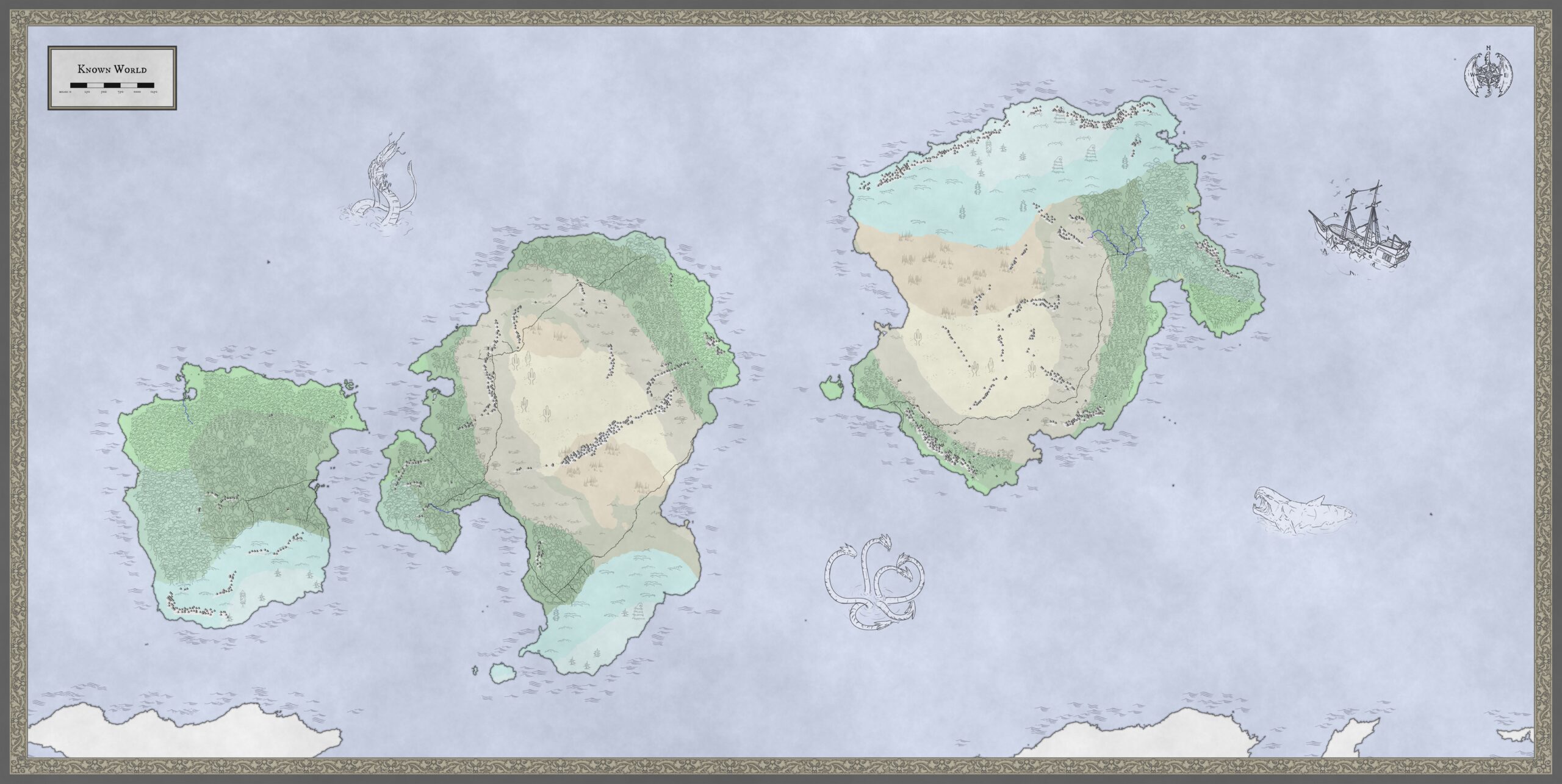
The seeds of the Empire’s decline were sown with the Darkwater Dynasty, whose veiled rule in the late seventh millennium brought whispered horrors. Even their fall in IM 7210 could not undo the damage and by IM 7500, a severe Tyndall Cycle proved to be the final nail in the coffin of the failing empire. The tides rose, drowning ports, severing trade, and pushing dwarven influence into retreat. The Doomspeaker dynas-ty that replaced the Darkwaters struggled to maintain imperial cohesion but when the empire withdrew in IM 7531, it did so completely. Bureaucrats abandoned the eastern territories, outposts shuttered, and the last envoys vanished into the mountains, never to be heard from again. Even Fyolafam, the imperial capi-tal, was lost—the world knows it lies in the far northwest of the central continent, yet no expedition has uncovered its gates. Those who venture too deep into the forgotten roads return with nothing, and many do not return at all.


The empire’s collapse may reside in the distant past, but its infrastructure, and aesthetics endure. Its roads still shape trade routes. Its laws echo in civic courts, and the imperial calendar (IM) remains the interna-tional standard. For most in daily life, however, the empire is a footnote.
Public interest in the empire and its history have waxed and waned over the centuries, but the discovery of the Treasure of Guarrazar in 8883 IM by an archaeological expedition from the University of Hoganea sparked unprecedented public interest. The treasure, found in a hidden chamber in the ruins of a fortified manor house, was the wealth and cultural legacy of the Darkwaters, preserved by them as a hedge against the Imperial purge that came after the throne was usurped by Iroth Doomspeaker, an interest that was re-kindled in 8993 IM when a centennial tour of many of the key artifacts from the treasure was undertaken.
There are still small scattered populations of Dwarves in the east and south of the central continent, the descendants of soldiers, bureaucrats and functionaries that never returned to the core of the empire, but the empire itself is gone, lost to time.